Last updated: June 2026. Ranking on Google India in 2026 requires different signals than ranking on Google US or UK: stronger weight on local relevance and Hindi/regional-language intent overlap, faster-growing mobile-first SERPs, heavier competition from aggregator and marketplace domains, and a search population where a large share of high-intent queries are price- or comparison-driven. The framework below is what’s used to get client pages to page one in Indian search results specifically.
How Google India search differs from Google US
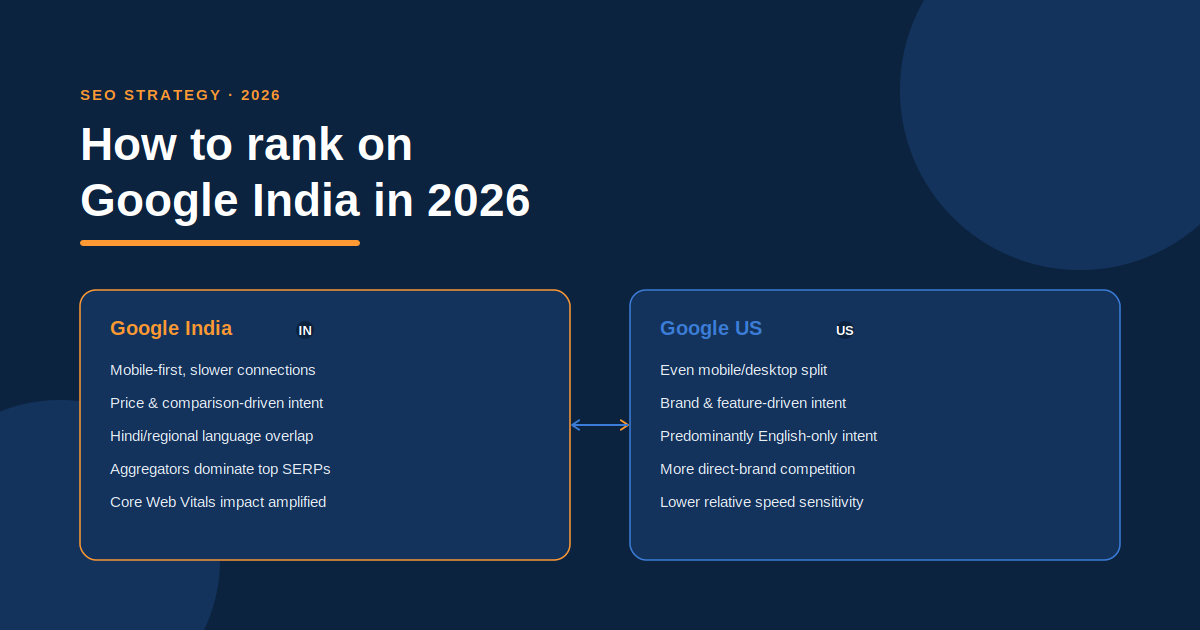
| Factor | Google India | Google US |
|---|---|---|
| Device mix | Mobile-dominant, often on slower connections | More even mobile/desktop split |
| Query intent | Heavier price- and comparison-driven intent | More brand and feature-driven intent |
| Language signals | English queries often mixed with Hindi/regional intent | Predominantly English-only intent |
| Top-of-SERP competition | Aggregators and marketplaces dominate many commercial queries | More direct-brand and DTC competition |
| Page speed sensitivity | Higher — slower average connection speeds amplify Core Web Vitals impact | Lower relative impact due to faster average connections |
The 5-part framework
1. Build for mobile-first, slow-connection reality
Median mobile connection speeds in much of India remain slower than in the US or UK, which means Core Web Vitals — especially Largest Contentful Paint — has an outsized impact on both rankings and conversion. A page that loads acceptably on a US 4G connection can feel broken on an Indian 3G/budget-4G connection. Test on throttled mobile conditions, not just desktop Lighthouse scores.
2. Map content to comparison and price intent
A large share of commercial queries in India (“best [category] in India,” “[product] price in India”) are explicitly comparison-driven. Pages that include direct pricing, comparison tables, and “best for” breakdowns tend to outperform pure feature-description pages for these queries.
3. Compete with aggregators directly, don’t ignore them
For many commercial categories, the top of Google India results are dominated by aggregator and marketplace sites with deep domain authority. Out-ranking them outright on broad terms is slow; the faster win is targeting longer-tail, more specific queries the aggregators don’t directly answer (e.g., a specific use case or city-level query) where a focused page can outrank a generic aggregator listing.
4. Use hreflang and locale signals correctly if you serve multiple markets
If you’re targeting India alongside the US or UK from the same domain, incorrect or missing hreflang tags can cause Google to serve the wrong page variant to Indian searchers, or worse, treat them as duplicate content. This is one of the most common technical gaps found in cross-market audits.
5. Build topical authority around buyer-stage content, not just keywords
Single-keyword-targeted pages rank slower than a cluster of related content (a pillar page plus supporting articles) that demonstrates depth on a topic. This matters more in competitive Indian commercial categories where domain-level topical authority is a stronger differentiator than any single page’s on-page optimization.
FAQs
How long does it take to rank on Google India for a competitive keyword?
For competitive commercial keywords against established aggregators, 4-8 months of consistent technical and content work is typical. Long-tail, comparison-style, or city-specific queries can rank in 6-10 weeks.
Does page speed matter more for ranking in India than in the US?
Google’s ranking algorithm itself doesn’t formally weight Core Web Vitals differently by country, but the practical impact is larger in India because median connection speeds are slower, so a borderline-slow page is more likely to cross into “poor” experience territory for Indian mobile users specifically.
Should I use a separate domain or subfolder for the Indian market?
A subfolder or subdomain with correct hreflang tagging on the same domain is usually sufficient and easier to manage than a fully separate domain, unless there are business reasons (separate entity, separate brand) requiring otherwise.
For a deeper technical and content audit specific to your site, see SEO Services, or work with a consultant focused on the Indian market directly.
How Google India Search Differs from Google US
Device mix, query intent, language signals, top-of-SERP competition, and page speed sensitivity all differ meaningfully between Google India and Google US — mobile-first, slower connections, and heavier price/comparison intent define the Indian search landscape.
The 5-Part Framework
Build for mobile-first, slow-connection reality; map content to comparison and price intent; compete with aggregators directly via longer-tail queries; use correct hreflang signals for multi-market sites; and build topical authority through content clusters rather than single keyword-targeted pages.
FAQs
Typical timelines to rank for competitive Indian keywords, whether page speed matters more for Indian rankings specifically, and whether a separate domain is needed for the Indian market.