
Most Indian startups treat SEO as something to figure out “later” — after product-market fit, after Series A, after the team is bigger. By then, three competitors have already claimed the keywords your ideal customers are searching, and you’re paying ₹8–₹20 per click for traffic that should have been free.
This guide is for founders and growth leads at Indian startups who want to build organic visibility before the paid budget runs out. No theory. No generic checklists. What works specifically for B2B SaaS, D2C, fintech, and edtech startups in the Indian market right now.
Why SEO Hits Different for Indian Startups
The Indian search landscape has two characteristics that make early SEO especially valuable for startups:
1. Low competition in the long tail. Global competitors rank for head terms. But search queries like “inventory management software for kirana stores” or “digital marketing consultant for D2C India” often have no strong competitor content — because the incumbents are targeting Western markets and the domestic players aren’t investing in content. First-mover SEO advantage is still available in most Indian startup verticals.
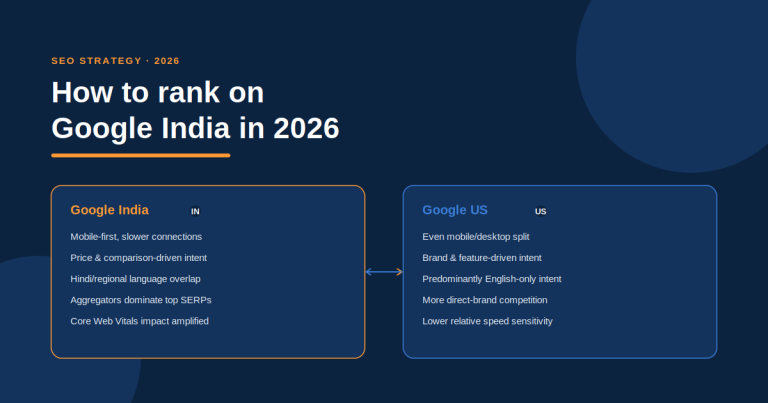
2. High-intent traffic from Tier 2 and Tier 3 cities. India’s next wave of SaaS buyers and D2C customers is not in Mumbai or Bengaluru. They’re in Surat, Jaipur, Lucknow, Coimbatore. These users are searching in English with India-specific intent (pricing in INR, GST compliance features, Hindi language support). Content that addresses their specific queries — not globalised generic content — converts at 3–4x the rate of imported Western SEO templates.
The 4-Phase Startup SEO Strategy
Phase 1: Foundation (Months 1–2)
Before any content, fix the technical baseline. Startup websites frequently fail basic SEO hygiene because the engineering team prioritised product speed over web performance:
- Core Web Vitals: LCP under 2.5s, CLS under 0.1. Most Indian startup sites run on cloud hosting with unoptimised images and render-blocking JavaScript. Use WebPageTest to measure, not just Lighthouse — real-world numbers from Indian IPs matter.
- Mobile-first indexing: Google indexes the mobile version of your site. If your mobile experience is an afterthought, your rankings reflect that.
- Crawlability: Make sure your sitemap is submitted to Google Search Console and all key pages are indexable. Startup sites frequently block /app, /dashboard, or /signup with robots.txt — fine — but sometimes accidentally block blog or product pages too.
- URL structure: Logical, keyword-informed hierarchy. `/features/inventory-management/` beats `/features/f1/`. You can’t fix URL structure at scale later without 301 chains everywhere.
Phase 2: Keyword Strategy (Month 2)
Startup founders make two mistakes with keyword research: (a) targeting head terms they can never rank for, and (b) ignoring search data entirely and writing “thought leadership” nobody is searching for.
The right framework for an Indian startup:
Jobs-to-be-done keywords: What is your customer trying to accomplish that your product solves? Map the keywords to the job, not to your feature list. “GST invoice generator” is a JTBD keyword. “Our platform’s intelligent invoicing module” is not a keyword anyone types.
Comparison keywords: “[Competitor] alternative”, “[Competitor] vs [Your brand]”, “best [category] software India”. These have high commercial intent and often rank faster than category-head terms because the content is more specific.
India-modifier keywords: Appending “India”, “for Indian businesses”, “in INR”, “GST-compliant” to otherwise competitive terms dramatically reduces difficulty. “HR software India” is achievable. “HR software” is not, competing with global giants.
Phase 3: Content Engine (Months 3–6)
Startups can’t out-publish the incumbents on volume. The alternative is depth: fewer articles, but each one so comprehensive and India-specific that it becomes the definitive resource for that query.
Content types that work for Indian startup SEO in 2026:
- Comparison guides (“Top 7 Inventory Management Apps for Indian Retailers — Compared by Price, GST Support, and Hindi UI”): High intent, high conversion, easy to maintain as the market changes.
- How-to guides targeting Indian compliance: GST filing, TDS, FEMA compliance, SEBI regulations, BIS certifications — every regulated sector in India has a search audience that Google struggles to serve with generic global content.
- Case studies with Indian metrics: Revenue in crores, growth in Indian market context, customer names your target audience recognises. A case study about “How a Pune D2C brand scaled from ₹30L to ₹2Cr monthly revenue using our platform” outperforms a generic global success story in Indian search results.
- Glossary/definition pages: Indian founders search terms like “what is D2C in India”, “what is CAC in marketing”, “performance marketing meaning in Hindi business context”. These informational pages drive top-of-funnel traffic and establish topical authority.
Phase 4: Authority Building (Month 4 onward)
Links from authoritative Indian publications move the needle faster than generic link-building tactics. Prioritise:
- Startup media features: YourStory, Inc42, Entrackr, The Ken. These publications link naturally and their domain authority transfers meaningfully.
- Industry association pages: NASSCOM, CII, FICCI, sector-specific associations often link to member companies and tech resources.
- PR-driven mentions: A funding announcement in Economic Times or a product launch covered by Mint brings links you can’t buy and brand signals Google treats as trust signals.
- Digital PR: Data-driven reports about your sector (“State of D2C in India 2026”) generate links from publications writing about the space.
SEO vs. Performance Marketing: The Startup Allocation Question
Most founders treat this as an either/or. It isn’t — they serve different time horizons. Performance marketing (Google Ads, Meta Ads) delivers traffic immediately and stops the moment you stop paying. SEO compounds: the article you publish in month 3 may drive 10 leads/month by month 12 and 40 leads/month by month 24, at zero marginal cost per lead.
A practical allocation for an early-stage Indian startup with a ₹3–5L/month digital marketing budget:
- Month 1–3: 70% performance marketing, 30% SEO foundation and content
- Month 4–9: 50/50 as organic traffic begins contributing to pipeline
- Month 10+: 40% performance, 60% SEO — by this point organic should be generating consistent inbound
The compounding effect of SEO is why starting early matters: a startup that begins SEO at Series A is 12 months behind one that started at seed.
Common SEO Mistakes Indian Startups Make
Hiring a cheap agency and expecting results in 30 days
₹10,000/month retainer agencies typically deliver link spam and low-quality blog posts that Google ignores or actively penalises. SEO competes with your competitors’ SEO investment. If they’re spending ₹80,000/month on quality content and links, spending ₹10,000 produces exactly zero competitive uplift.
Ignoring Google Search Console
GSC tells you exactly what queries are driving impressions, which pages have high impressions but low CTR (a title/description problem), and which pages have indexation issues. Most startups set it up, verify, and never look at it again. Looking at it weekly for the first six months is one of the highest-ROI activities in early-stage SEO.
Publishing AI content without expert review
Google’s 2025 Helpful Content updates have specifically targeted thin AI content that lacks first-hand expertise. Indian startup blogs filled with AI-generated generic articles are not ranking — and in some cases are dragging down the entire domain. The fix isn’t to avoid AI; it’s to use AI for structure and research and have a domain expert add the specific, experience-based insights that make content genuinely useful.
What to Look for in an SEO Consultant for Your Startup
An SEO services for startups in India who understands startup constraints and market dynamics is different from a generic agency. Look for:
- Demonstrable experience in your specific vertical (B2B SaaS SEO is different from D2C SEO)
- Transparency about timelines — anyone promising page-1 rankings in 30 days is lying
- A clear content strategy, not just a link-building proposal
- Reporting tied to business metrics (pipeline influenced, MQL from organic) not vanity metrics (domain authority, keyword positions for terms nobody searches)
- Case studies with Indian clients, not globalised portfolios
The 90-Day Startup SEO Audit Checklist
Before spending on content or links, work through this list:
- Google Search Console set up and verified ✓
- XML sitemap submitted and indexed ✓
- Core Web Vitals passing on mobile (LCP <2.5s, CLS <0.1) ✓
- No accidental noindex on key pages ✓
- Title tags and meta descriptions unique on every page ✓
- Homepage clearly communicates what you do, who you serve, and where ✓
- 10 target keywords identified with monthly search volume data ✓
- Top 3 competitor domains analysed for content gaps ✓
- Content calendar for next 90 days mapped to keyword targets ✓
- At least 1 link-worthy asset (report, tool, dataset) in production ✓
Not sure where your current SEO stands? Get a free digital marketing audit â your rankings, content gaps, and technical issues mapped before you invest in a full strategy.
Getting organic search right from the start is one of the highest-leverage decisions an Indian startup can make. If you want an SEO strategy built for your specific vertical and stage, let’s talk.
Frequently Asked Questions About SEO for Startups in India
How long does SEO take to show results for an Indian startup?
For most Indian startups, the first meaningful organic traffic from SEO shows up between months four and six after beginning content and technical work. Page 1 rankings for target keywords typically arrive between months six and twelve. The timeline depends heavily on how competitive your keyword category is, how much content you are producing, and whether your technical foundation is clean. Startups in underserved Indian verticals with low competition can see results faster.
How much should an Indian startup spend on SEO?
Early-stage startups with limited budgets should allocate at least Rs 30,000 to Rs 80,000 per month to SEO to see real progress. This covers a mix of content production, technical fixes, and link building. Agencies offering SEO for Rs 10,000 per month are typically producing work that does not move rankings. Startups at the Series A stage should consider Rs 1.5L to Rs 3L per month if SEO is a core acquisition channel in their growth plan.
Is SEO or paid advertising better for Indian startups?
They serve different purposes and different time horizons. Paid advertising (Google Ads, Meta Ads) delivers traffic immediately and stops the moment you stop spending. SEO builds over time and creates traffic that compounds without ongoing cost. For Indian startups, the right answer is almost always both, with the allocation shifting from paid-heavy early on to SEO-heavy as organic traffic matures. A startup that neglects SEO in years one and two is typically paying significantly more for the same traffic in years three and four.
What keywords should an Indian startup target first?
Start with keywords that are specific to what you do, have clear commercial intent, and have a realistic chance of ranking given your current domain authority. In practice, this means long-tail keywords with India-specific modifiers. Instead of targeting “HR software,” target “HR software for small businesses India” or “HR software with GST integration.” These convert better, rank faster, and give you real data on which segments of your audience are most active in search.
How do I know if my startup’s SEO is working?
The clearest signal is organic clicks from Google Search Console rising month over month for keywords that are relevant to your business. Secondary signals include your pages moving from page three or four to page one for target keywords, and organic traffic appearing in your Google Analytics acquisition report. Vanity metrics like domain rating or number of keywords tracked do not matter if they are not translating into actual visitors and leads.
Do Indian startups need backlinks to rank on Google?
Yes, but the quality of links matters far more than quantity. One link from YourStory, Inc42, or an established Indian industry publication does more for your rankings than 50 links from low-quality directories or guest post farms. For most Indian startup verticals, building genuinely useful content that earns links naturally combined with targeted PR efforts in startup media is more effective than paid link-building campaigns.
Should I hire an SEO agency or a consultant for my startup?
For startups at the early stage, a specialist SEO consultant who has worked with similar businesses in your sector typically delivers better results than a generalist agency. Agencies often assign junior staff to lower-budget accounts. A senior consultant working directly on your account is more likely to understand the nuances of your market and make decisions that actually move rankings. As your marketing function grows, an agency relationship makes more sense for ongoing execution while a consultant or in-house team handles strategy.
If you want a clear picture of where your startup’s SEO currently stands, a free digital marketing audit covers your current rankings, traffic trends, technical issues, and the content gaps your competitors are filling that you are not.