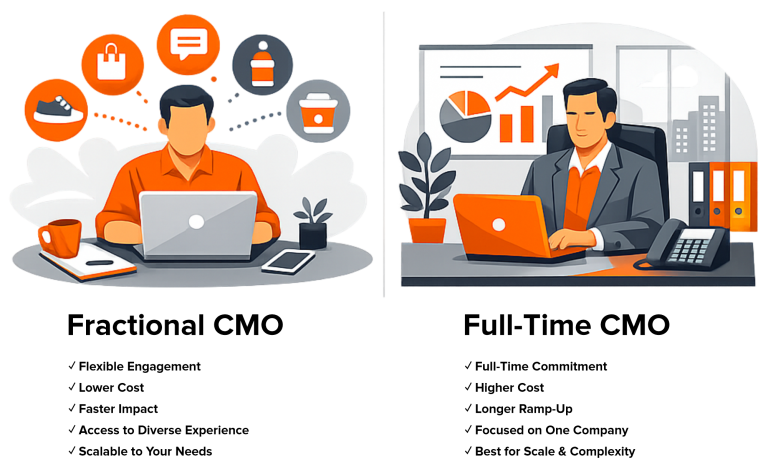

My name is Namit Behl. I am a fractional CMO and digital marketing consultant based in India, working with US companies, Indian startups, and mid-market businesses that need senior marketing leadership without the cost or commitment of a full-time CMO hire. This page covers how I work, what clients can expect, and what makes the fractional CMO model the right fit for a specific stage of business.
What I Do as a Fractional CMO
As a fractional CMO, I step into the marketing leadership role that a full-time Chief Marketing Officer would fill, but on a part-time basis. I typically work with two to four clients at any given time, dedicating a set number of days per month to each engagement. The work covers strategy, team direction, channel prioritization, agency oversight, and board-level reporting.
What this means practically: I am not delivering a report and leaving. I am embedded in your business, attending leadership meetings, managing your marketing team or external agencies, owning the marketing roadmap, and taking responsibility for the outcomes. The fractional part refers to the time, not the involvement.
Who I Work With
My fractional CMO engagements typically fit one of three profiles:
- US startups and SMBs between $2M and $30M in revenue that have grown marketing past one person but are not yet at the scale where a $200K CMO salary makes sense. These companies need someone who can build structure, set strategy, and raise the quality bar across all marketing activity without the overhead of a full-time executive hire.
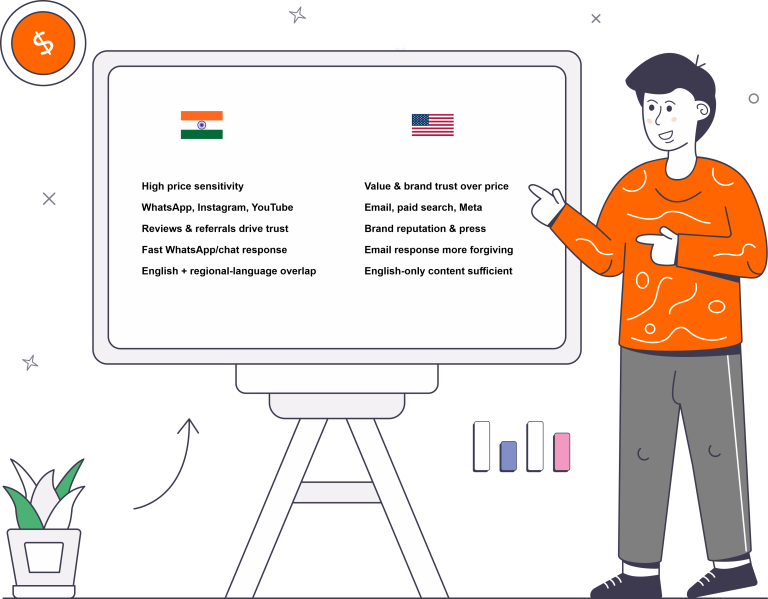
- Indian companies expanding to the US market that need a senior marketing leader who understands both markets. I bridge the strategic gap between what works for Indian audiences and what American buyers actually respond to, covering brand positioning, channel selection, content strategy, and paid media for the US market specifically.
- PE-backed mid-market companies preparing for a growth push, a rebrand, or a new market entry. These engagements often have a fixed timeline and a clear mandate — a specific revenue target to hit, a product launch to execute, or a marketing function to rebuild before a sale or raise.
My Approach to Fractional CMO Engagements
Every engagement starts the same way regardless of industry or geography: I spend the first two to four weeks understanding where the business actually is before changing anything. This means reviewing your analytics, your ad accounts, your CRM data, your content, and your competitive landscape. Bad diagnosis leads to expensive mistakes, and most marketing problems I encounter are not what the client thinks they are when we first speak.
Discovery and Audit
The audit phase covers current channel performance, attribution gaps, team capability, vendor performance, and the competitive environment. I come out of this phase with a clear picture of what is working, what is wasted spend, what is missing, and what should be done first. This becomes the strategic baseline for everything that follows.
Strategy and Roadmap
The strategy phase produces a 90-day marketing roadmap that the team can actually execute. I prioritize ruthlessly. Most marketing teams I work with are trying to do too many things simultaneously. The roadmap cuts the list to what will actually move the revenue needle in the next quarter and builds clarity about what gets deprioritized and why.
Execution and Oversight
Depending on the engagement scope, I either manage execution directly alongside your team, or I set the direction and oversee your agency relationships. I am available for real-time Slack communication, weekly team calls, and leadership meetings. Ad hoc decisions, campaign reviews, and agency briefings happen inside the engagement without extra billing.
Reporting and Iteration
I track and report on a small number of metrics that are directly connected to business outcomes. I do not produce vanity dashboards. Reporting is designed for founders and leadership teams who want to understand whether marketing is working, not for marketing teams justifying their own existence. We review what changed, what we learned, and what the next quarter’s priorities are as a result.
Results from Fractional CMO Engagements
A few examples of outcomes from past fractional CMO work:
- Took an Indian B2B SaaS company from zero to 4,500 monthly US organic visitors in nine months through a combined SEO and content strategy targeting the American mid-market.
- Reduced Google Ads cost-per-trial for a US SaaS client from $180 to $62 within 90 days by restructuring campaign architecture and improving landing page conversion.
- Built a content and LinkedIn strategy that generated 40 or more qualified US inbound leads per month for a B2B professional services firm within six months of engagement start.
- Helped a PE-backed Indian company reposition its brand for the US enterprise market, including a full website rebuild, new messaging hierarchy, and a thought leadership content program that established category presence in under a year.
These results are representative of clients who invested in the process and gave the work time to compound. Marketing does not produce linear outcomes and any fractional CMO who promises specific revenue numbers in a sales call is selling a guarantee they cannot deliver.
What a Typical Engagement Looks Like Week to Week
For a typical eight-day-per-month fractional CMO engagement, the working week looks something like this. Two days go to strategy, planning, and writing: reviewing last week’s data, refining the roadmap, and producing the thinking that guides the team. Two to three days go to team and agency management: reviewing work, giving feedback, attending calls, and making tactical decisions. The remaining days go to execution: writing briefs, reviewing copy, signing off on creative, and handling any escalations that need senior judgment rather than delegation.
Communication happens primarily over Slack for US clients, with weekly or bi-weekly video calls scheduled to overlap with US morning hours. The async-first model works exceptionally well for US clients because work gets done and reviewed overnight relative to their time zone, meaning progress is visible every morning when they start the day.
How to Start a Fractional CMO Engagement
The process starts with a 30-minute discovery call. Before that call, I will ask you to share your current Google Analytics, any ad platform data you can pull, and a brief on what you are trying to achieve in the next 12 months. This gives me enough to ask the right questions and give you an honest read on whether a fractional CMO engagement is the right fit for your situation, not just a yes that gets you into a contract.
After the discovery call, if there is a fit, I will propose an engagement structure covering scope, days per month, duration, and pricing. Most engagements start with a 90-day pilot to establish the working relationship before moving to a longer-term arrangement. The pilot gives both sides the information needed to make the longer commitment with confidence.
Frequently Asked Questions About Working with Namit Behl as a Fractional CMO
What is Namit Behl’s background in marketing?
I have eight-plus years of experience working across SEO, paid media, content marketing, and brand strategy for clients in India, the US, and the UK. My work spans B2B SaaS, professional services, e-commerce, and Indian companies expanding to Western markets. I have worked both as an in-house marketing lead and as a consultant, which gives me a realistic understanding of what is executable inside a business, not just what looks good in a strategy deck.
Is Namit Behl available for US-based fractional CMO engagements?
Yes. The majority of my fractional CMO clients are US-based or are Indian companies with US market expansion as a primary goal. The engagement is fully remote, which means geography is not a constraint. I have worked with clients across EST, CST, PST, and IST time zones without it being a barrier to quality work or communication.
How is working with Namit Behl different from hiring a US-based fractional CMO?
The primary difference is cost. A US-based senior fractional CMO typically charges $10,000 to $22,000 per month. My engagements are priced significantly below that range for equivalent strategic quality, reflecting my India-based cost structure rather than any difference in the depth or sophistication of the work. For US companies open to a remote-first senior engagement, this represents a genuine cost advantage without a capability trade-off.
What channels does Namit Behl focus on as a fractional CMO?
I am channel-agnostic in the sense that the right channel depends entirely on the business and its customers, not on what I personally prefer. In practice, most engagements involve a combination of SEO, paid search, content marketing, and paid social. For US B2B clients, LinkedIn Ads and Google Search tend to be the highest-ROI channels. For D2C and consumer-focused clients, Meta Ads and organic content play a larger role. I have hands-on experience managing all of these at both the strategic and executional level.
What is the minimum engagement for working with Namit Behl?
Most fractional CMO engagements start with a 90-day commitment. This is long enough to complete a proper audit, build a strategy, begin executing, and see early indicators of whether the direction is right. Month-to-month arrangements are possible after the initial 90 days, though most clients find the working relationship productive enough to continue. One-off projects like go-to-market strategy development, a US market entry plan, or a marketing audit are also available for companies not ready for a full fractional engagement.
How do I know if I need a fractional CMO or just a marketing consultant?
A consultant typically delivers a specific deliverable and advice. A fractional CMO takes ongoing ownership of the marketing function. If you need someone to write your content strategy and leave, you need a consultant. If you need someone to build the marketing function, manage the team, run the channels, and report to the board, you need a fractional CMO. The distinction matters because fractional CMO engagements are structured for continuity, not project completion. The value compounds over time as the fractional CMO builds context about your business and your market.
Does Namit Behl take on clients in any industry?
I prefer engagements where I have category-relevant experience: B2B SaaS, professional services, consulting, technology-enabled services, and Indian companies with US or global ambitions. I am cautious about industries where domain knowledge matters as much as marketing knowledge, such as healthcare, legal, or financial services, unless there is relevant prior experience. The best engagements are ones where I can add value quickly because I already understand the customer, the competitive landscape, and the category dynamics.
If you want to explore whether a fractional CMO engagement is the right fit for your business, read more about how I work as a fractional CMO or request a free digital marketing audit to start with a clear picture of where your marketing stands today. US companies can also review the digital marketing consultant services for US businesses.