India’s performance marketing ecosystem grew by over 40% between 2023 and 2025. Meta Ads, Google Ads, and programmatic buying are now table stakes for D2C brands, fintech apps, edtech platforms, and B2B SaaS companies targeting Indian audiences. Yet the median Indian advertiser is getting a fraction of the ROI they could — because performance marketing in India requires a different playbook than what works in the US or UK.
This guide breaks down how to structure a performance marketing strategy for the Indian market, how to measure digital marketing ROI properly, and what separates the advertisers driving 4–5x ROAS from those burning budget with nothing to show.
What Performance Marketing Actually Means
Performance marketing is paid digital advertising where you pay based on measurable outcomes — clicks, leads, app installs, purchases — rather than impressions or reach. The defining characteristic is accountability: every rupee spent is traceable to a result.
The main channels in the Indian performance marketing stack:
- Google Search Ads: Intent-driven; users are actively searching for what you offer. Highest conversion rates but also highest CPCs in competitive categories.
- Meta Ads (Facebook + Instagram): The dominant channel for D2C brands and B2C consumer apps. India has 400M+ active Facebook/Instagram users — the reach is unmatched, but creative fatigue is a real problem at scale.
- Google Performance Max: Automated cross-channel campaigns across Search, Display, YouTube, and Gmail. Powerful but requires careful exclusion lists to avoid wasting budget on irrelevant placements.
- YouTube Ads: Massively underused by Indian advertisers relative to the audience size. India has one of the world’s highest YouTube watch-time figures; video ads cost a fraction of what they cost in Western markets.
- Programmatic Display: Relevant for brands at scale (₹10L+/month) where retargeting and prospecting via DSPs makes sense.
Performance Marketing vs. Brand Marketing: The Indian Context
Indian marketing budgets have historically over-indexed on performance and under-invested in brand. The logic is understandable: performance is measurable, brand is not. But there’s a compounding problem: pure performance marketing creates a business where the moment you pause ads, revenue stops. No brand equity means no organic search demand, no word-of-mouth, no pricing power.
The most successful Indian D2C brands — Mamaearth, boAt, Lenskart at their growth stages — ran performance for customer acquisition and brand building simultaneously. Performance drove the immediate CAC economics. Brand drove down CAC over time as aided and unaided awareness grew.
A practical starting framework for Indian startups: allocate 70–80% of paid budget to performance channels (measurable acquisition) and 20–30% to brand-building (YouTube reach campaigns, content amplification, influencer) once you’ve validated your performance unit economics.
How to Measure Digital Marketing ROI in India
Most Indian advertisers track the wrong metrics. Clicks, impressions, and CTR are inputs. The metrics that matter are outputs:
For D2C and eCommerce
- ROAS (Return on Ad Spend): Revenue ÷ Ad Spend. A 3x ROAS means every ₹100 in ads generated ₹300 in revenue. Healthy ROAS benchmarks vary by category: fashion (3–4x), electronics (4–6x), beauty/personal care (3–5x). But ROAS alone doesn’t account for margins — a 4x ROAS business with 20% gross margins may be losing money.
- MER (Marketing Efficiency Ratio): Total Revenue ÷ Total Marketing Spend. Accounts for organic, direct, and paid traffic together — a more honest picture of efficiency than channel-level ROAS.
- CAC (Customer Acquisition Cost): Total marketing spend ÷ New customers acquired. Compare to LTV (Lifetime Value) — a CAC:LTV ratio of 1:3 or better is the general benchmark for a viable D2C business.
- Payback Period: How many months to recover the CAC from a customer’s gross profit contribution. Indian D2C businesses targeting profitability should aim for sub-12-month payback periods.
For B2B and SaaS
- CPL (Cost Per Lead): Total spend ÷ leads generated. Benchmark heavily by quality — a ₹500 CPL from Google Search with 15% close rate beats a ₹200 CPL from broad Meta campaigns with 3% close rate.
- SQL Rate: What % of marketing-generated leads become Sales Qualified Leads? Low SQL rate indicates targeting or messaging misalignment, not just lead volume problems.
- Pipeline Influenced: How much of the sales pipeline (by value) had at least one performance marketing touchpoint. In B2B, first-touch attribution understates performance marketing’s role because sales cycles are long and multi-touch.
- CAC by Channel: Break down cost-per-customer by acquisition channel. Indian B2B companies consistently find that LinkedIn Ads have high CPL but produce larger-ACV deals; Google Search has moderate CPL with predictable close rates; Meta has the lowest CPL but the lowest close rates for enterprise audiences.
India-Specific Performance Marketing Tactics That Work
Meta Ads: Go Vernacular
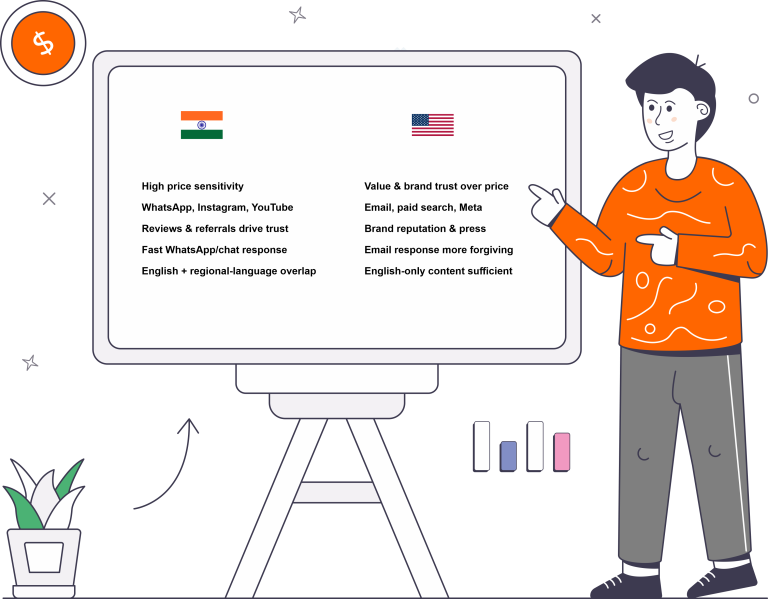
Hindi-language creatives consistently outperform English-language creatives for audiences outside metro cities. This sounds obvious but the majority of Indian brands still run English-primary ad campaigns to audiences whose first language is Hindi, Tamil, Telugu, Kannada, or Marathi. A/B test vernacular copies — the CPAs are often 30–50% lower for the same audience.
Google Ads: Bid on India-Specific Buying Signals
Keywords like “EMI available”, “no cost EMI”, “GST invoice”, “GST input credit” have high commercial intent in India that doesn’t translate in Western search behaviour. If you sell high-consideration products (electronics, software, services above ₹10,000), adding these terms to your keyword strategy captures a motivated buyer segment that generic category keywords miss.
YouTube Ads: Underpriced Reach
CPV (cost-per-view) rates in India are 5–10x lower than in the US for comparable audiences. A brand awareness campaign that would cost ₹50L to run in the US costs ₹5–8L in India with comparable reach. D2C brands and consumer apps that invest in YouTube video creative and run skippable in-stream ads against interest-targeted audiences are seeing brand search volume lift that compounds over time.
Retargeting: The Abandoned Cart Crisis
India has one of the world’s highest cart abandonment rates — over 80% on mobile eCommerce. The primary reason is UX friction (payment failures, long checkout flows) not purchase intent issues. Retargeting campaigns that bring back abandoned cart users within 15–60 minutes see conversion rates 4–8x higher than cold prospecting campaigns. If you’re not running a dedicated abandonment retargeting sequence, you’re leaving your easiest conversions on the table.
Building a Performance Marketing Stack for India
The tooling you need at different budget stages:
Seed Stage (₹1–5L/month)
- Google Ads + Meta Ads (the two essential channels)
- Google Analytics 4 for attribution (free, sufficient at this stage)
- Google Search Console for organic visibility tracking
- Hotjar or Microsoft Clarity for landing page behaviour (free tiers adequate)
Growth Stage (₹5–25L/month)
- Add YouTube Ads to the mix
- Dedicated landing page tool (Unbounce, Instapage) for CRO testing
- WhatsApp Business API for retargeting (extremely effective for Indian audiences — open rates of 70%+ vs. 20% for email)
- Basic CDP or CRM for customer segmentation (Clevertap, MoEngage are India-friendly options)
Scale Stage (₹25L+/month)
- Programmatic DSP for reach extension beyond Meta/Google
- Incrementality testing to understand true lift from paid channels
- Marketing Mix Modelling (MMM) for budget allocation across channels
- Data warehouse (BigQuery or Snowflake) feeding a unified attribution model
The Performance Marketing Traps Indian Brands Fall Into
Last-click attribution
Last-click attribution gives 100% credit to the final touchpoint before conversion. In India’s multi-device, multi-session purchase journeys, this massively overvalues branded search campaigns (which capture intent created by other channels) and undervalues top-of-funnel activity. Move to data-driven attribution in GA4 to get a more accurate picture, or at minimum use linear attribution while GA4 data accumulates.
Optimising for click, not for business outcome
A campaign that drives cheap clicks to a landing page with a 0.5% conversion rate is worse than a campaign that drives expensive clicks to a page converting at 4%. The optimisation lever that most Indian advertisers ignore is the post-click experience — landing page speed, mobile UX, form length, trust signals. Fixing CRO on existing traffic routinely delivers 2–3x ROI improvements with zero increase in ad spend.
Scaling spend before validating unit economics
The most expensive mistake in Indian startup performance marketing: scaling ad spend before validating that the CAC is recoverable from customer lifetime value. If your 30-day ROAS is 2x but your contribution margin is 25%, you’re acquiring customers at a loss. Scale only after you’ve proven that cohorts of customers acquired at your target CAC actually deliver the projected LTV — which requires at minimum 3–6 months of data per cohort.
Hiring a Performance Marketing Expert in India
Whether you’re hiring in-house or working with a performance marketing consultant, look for:
- Demonstrated experience in your category (D2C, B2B SaaS, fintech — these are not interchangeable skill sets)
- Ability to speak in business metrics (CAC, LTV, MER) not just platform metrics (CTR, CPC, ROAS)
- Honest about what’s achievable with your budget — anyone promising 10x ROAS in the first month is not being honest
- A testing-led approach: the first 4–6 weeks should involve rapid creative and audience testing, not “set and forget” campaigns
- Transparency in reporting — real numbers, real attribution, not cherry-picked winning campaigns with averages hidden
Running paid ads in India but not seeing the ROI you need? A performance marketing audit often surfaces 2–3 immediate fixes worth more than months of optimisation. Get a free audit.